
- HOME
- Retinal pigment epithelial cells (HLCR011)
The eye has a structure like a camera, where the crystalline lens corresponds to the camera’s
lens and the retina corresponds to the film or sensor. The retinal pigment epithelium (RPE) is a monolayer of
cells located at the outermost part of the retina, adjacent to the photoreceptors. Photoreceptors convert light
entering the eye into electrical signals, while the RPE cells provide nutrients to photoreceptors and removes
waste products, helping to maintain the retina in a healthy state.
An RPE tear is a condition in which the RPE layer ruptures and contracts, resulting in partial loss of the layer.
RPE tear is thought to be due to tractional force on the RPE cell layer caused by complications
following anti-VEGF (vascular endothelial growth factor) drug administration for age-related macular
degeneration or trauma.
When RPE tear occurs in the macula—the central part of the retina that is critical for vision—it can lead to
severe visual impairment and visual field defects.

Current Treatment
RPE tears can be diagnosed based on the appropriate examinations by ophthalmologists.
However,
there is currently no established treatment available.
Our Goal with Regenerative
and Cellular Therapy
Immediately after the onset of RPE tears, the loss of RPE cells leads to disruption of the
metabolic cycle (RPE-photoreceptor interaction) for retinoids necessary for light perception, as well as the loss
of the blackout effect that prevents light scattering. This contributes to a worsening of visual function.
Subsequently, the continued impairment of waste removal from photoreceptors and deficiency in the secretion of trophic factors leads to the loss of normal photoreceptors, ultimately resulting in irreversible visual impairment.
As a treatment for these disorders, a suspension of RPE cells derived from allogeneic iPS cells with normal function is transplanted into the lesion site. Transplanted RPE cells are expected to successfully integrate and restore the retinal layer structure. Once integrated, they are anticipated to function properly, thereby maintaining or even improving visual function.
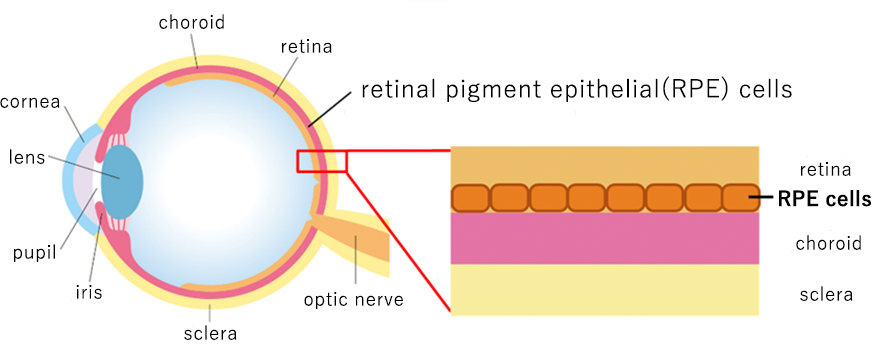

Photo: From Color Atlas of Fundus Photography, 7th Edition /
Reprinted with permission from Nihon Iji Shinpo Publishing Co., Ltd.